A friend asked if my current printmaking preoccupation with churches had any element of faith to it. My answer was “no” but it did get me to thinking about what draws me to churches which led to a tangled scribble of thoughts.
For the last few years most of what I end up making art about has related to my experience as a cyclist. This makes sense. I stopped making art for around a decade due to disillusionment and economics. That is when riding a bike regularly became a large part of my life again, after an almost twenty year hiatus. In turn, over time the things I saw and thought whilst cycling reignited a need to create something again. I suspect that desire was lying dormant and just needed a prod. Photography and writing, this blog essentially, was how that manifested itself. Shuffling pixels and words was fun but slowly I remembered the satisfaction of making actual things with your hands. No longer having a studio meant space and mess making options were limited. Painting was out but I could make linocut prints on my desk.
The first prints I made were of the South Downs in Sussex, the area where I do most of my cycling. I continued to make linocuts as I embarked on a year long series of audax rides in northern France. Images thematically linked by water tower motifs and branching into screenprinting as my ideas outgrew my lino cutting abilities or simply wanting to try new things. When that project came to an end, or temporary on hold as nothing is ever really finished, I started to think about what might be next. Returning to the Downs and Sussex local churches sprang to mind.

Churches have featured in multiple rides over the years from ad hoc stopping off to look at a church to routes deliberately plotted to take in specific locations. Places of stillness in days of movement. More than once I’ve visited the church at Lullington after seeing Eric Ravilious’s beautiful wood engraving. It was because of Ravilious that I started to think about printing making as a way of making images again. Hearing Robert MacFarlane and Johnny Flynn on Radio 4 walking in Hampshire and visiting Steep church with windows dedicated to Edward Thomas was a good enough reason for me to ride there and back one Saturday. From where my parents live in France I’ve ridden to Le Saillant to see windows by Marc Chagall. Connecting back to Sussex I’ve ridden to Tudeley and Chichester to see Chagall windows. Also in France I’ve done rides in the north and south to see stained glass windows by Georges Braque and Pierre Soulages. Braque’s windows (and his grave as it happens) are at a church painted by Monet. One of the water tower audax rides was to Giverny to visit Monet’s house. It’s a tangled web of connections.

However my interest in religious architecture goes back further. I studied painting at Canterbury and the cathedral featured in photographs in the my first year. I was always intrigued by the chapels designed by Le Corbusier and Tadao Ando. My degree show was a minimal meditative space with low lighting influenced by both these architects and Mark Rothko. Whenever I visit the National Gallery I inevitably end up in the early renaissance rooms scrutinising the compositions. There’s the catalogue from Dennis Creffield’s English Cathedrals exhibition at Camden Arts Centre in 1990 on the bookshelf next to me. Clearly there is something that attracts me to these buildings.

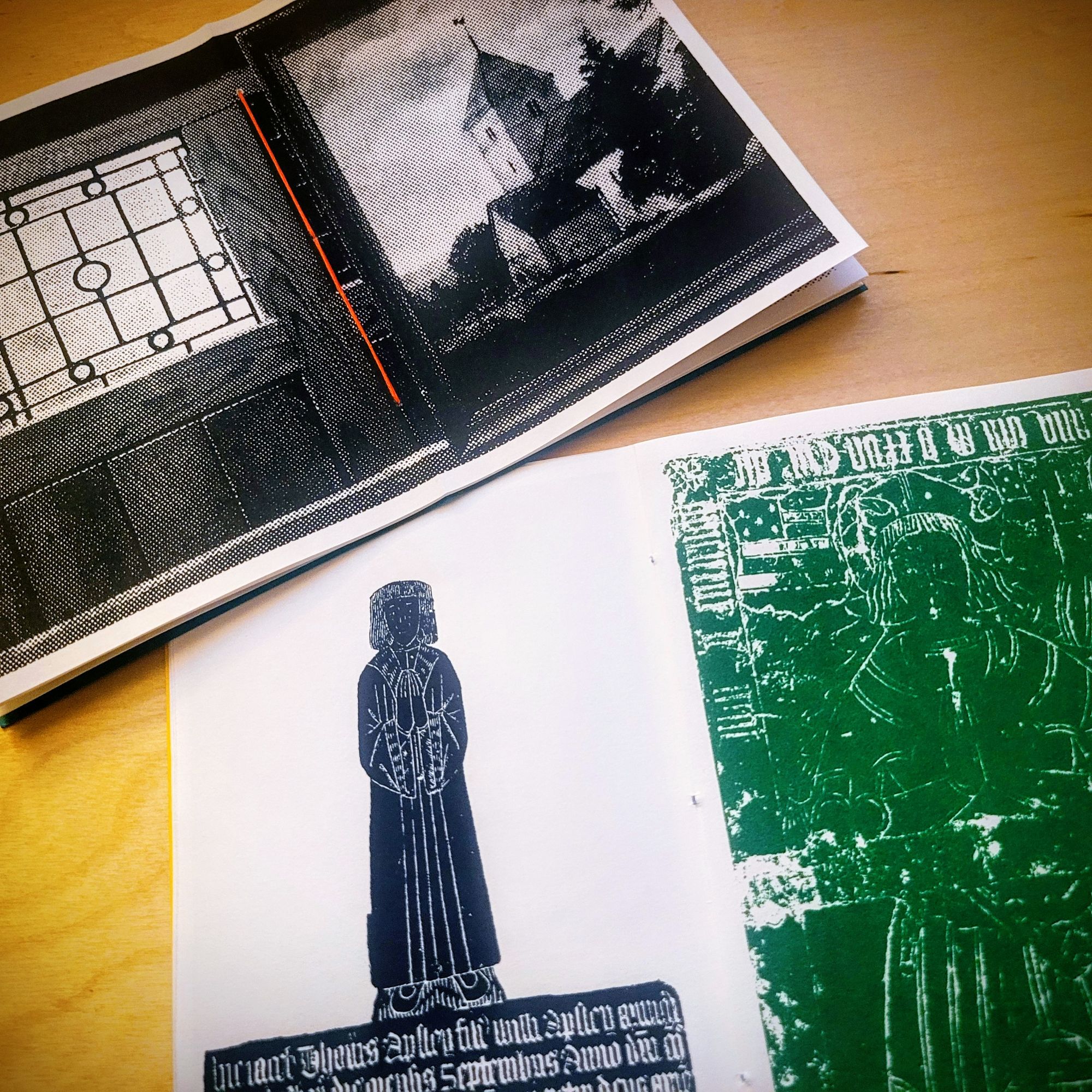

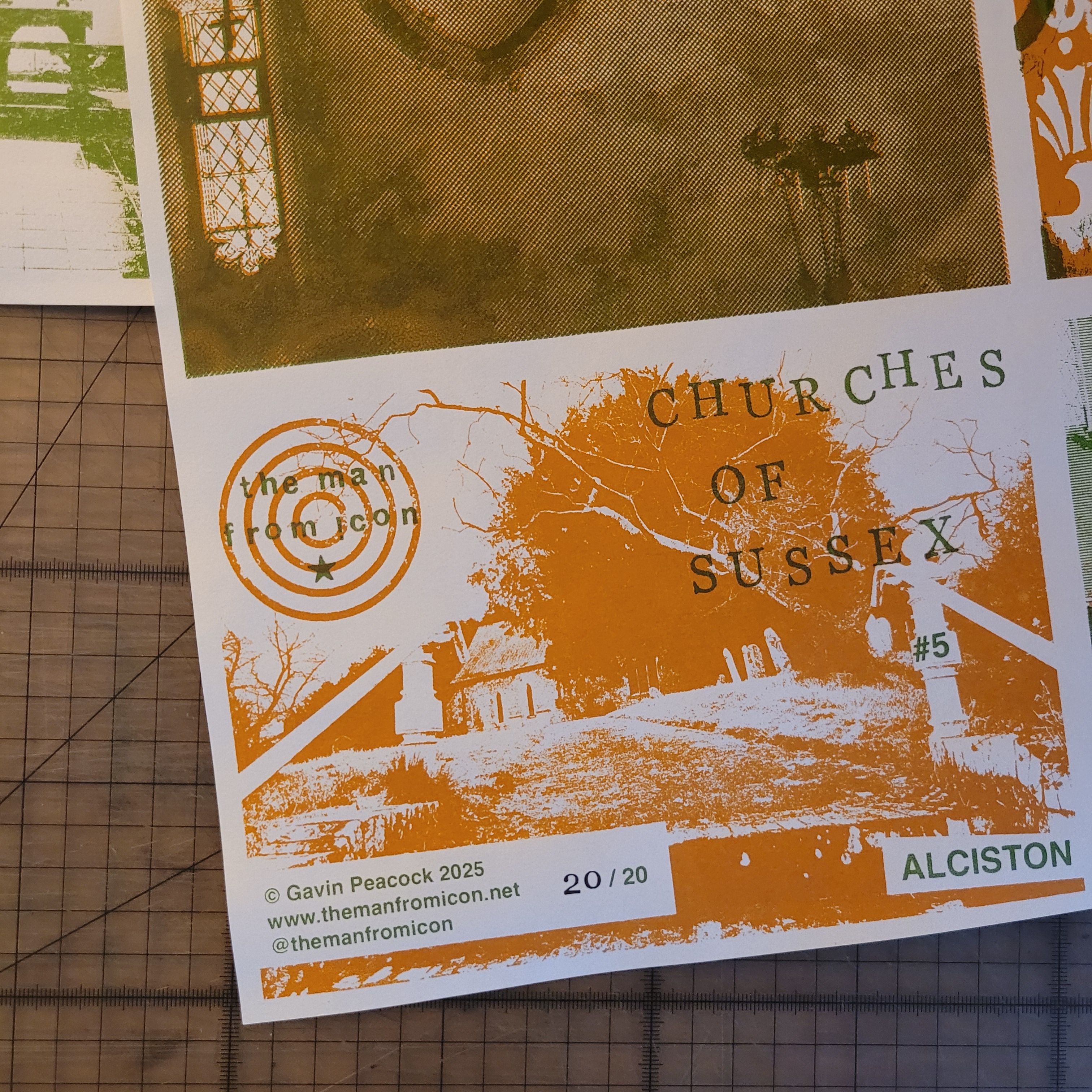

Pattern and repetition have always appealed and featured in whatever I’ve made over the years, from paintings to sculptures to videos and photographs and now prints. Churches are full of recurring motifs and images: Tiled floors, stained glass windows, carved panels, hassocks, rows of pews and organ pipes. Even the building itself is often built on a pattern. Patterns on top of patterns. I love patterns.
The atmosphere of a church appeals, the sense of history and place, the quiet and the solace. They are good places to sit and think. They offer a hiding place from the noise of the modern world. They’ve offered physical sanctuary on more than one long distance ride. On the Transcontinental we napped in the porch of a church in France and slept in the lee of a church somewhere in Poland. During Normandicat I bivvied down under roof of a porch in Normandy. Pleasingly they are often the right size for a bicycle and a prostrate human body. If you’re really lucky there is a bench you can lie on. I’ve sheltered from the rain in others, eaten lunch on churchyard benches and on more than one occasion across southern and central Europe, the Catholic bits, I’ve been delighted to find a graveyard tap to refill an empty bidon.


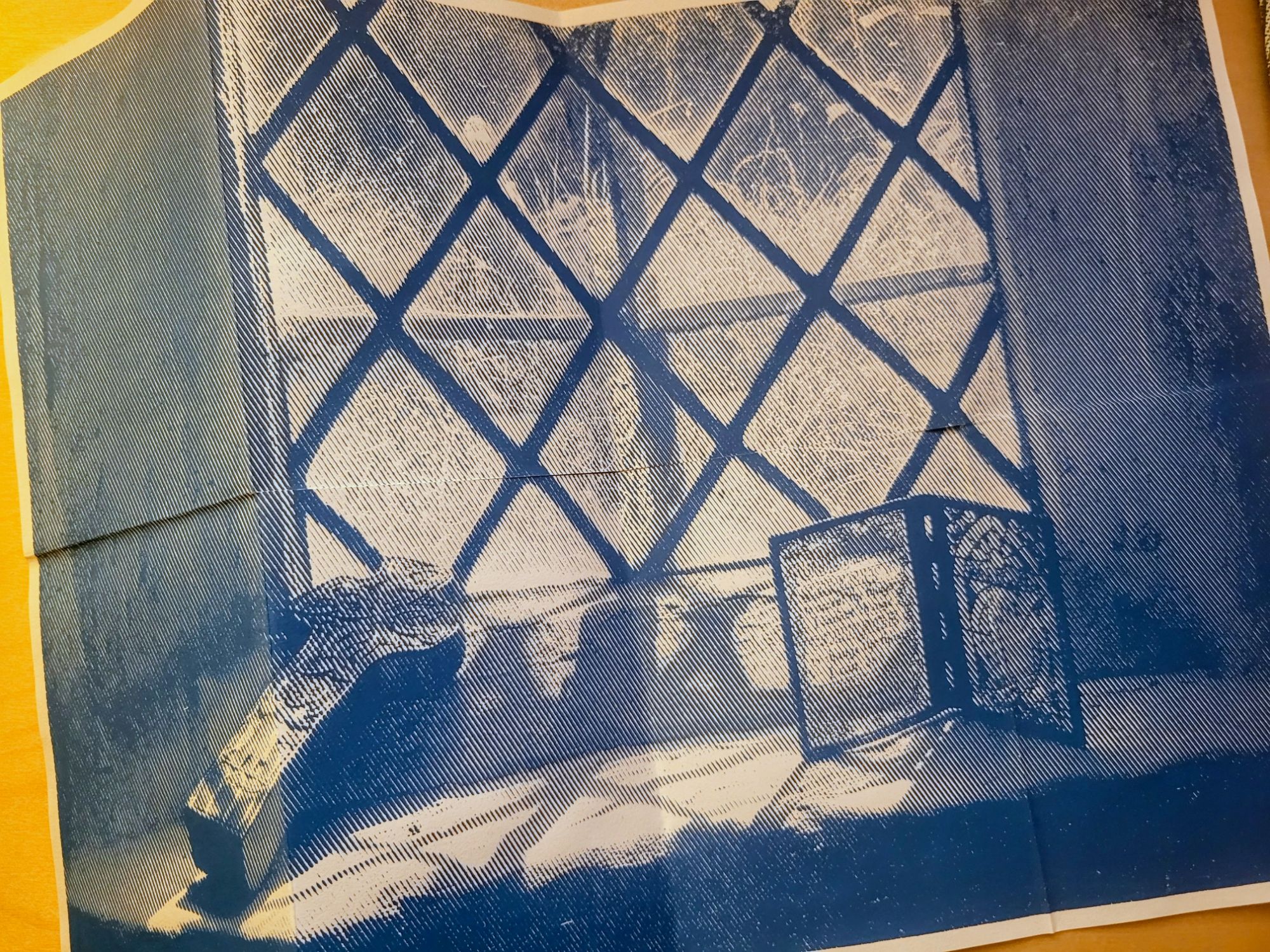
In the Protestant north you tend to have to wait for a petrol station, bar or shop if you need hydration. However here church spires and towers are handy landmarks. You can ride long distances across flat plains with not much sense of distance or where you might be. A spire poking up from the horizon indicates a village or town, with a bit of luck one with a bakery or bar.
Churches encompass a multitude of artforms – architecture, painting, music, wood-carving, ceramics, metalwork, embroidery, flower arranging – across vast swathes of time, in human terms at least and there is no hierarchy of maker. For every painting or window or tapestry created by an artist you can read about in a book there are hundreds of objects and images made by unknown hands all of equal importance. A print and a church are often a multilayered thing. Over a period of time parts have been added, built over, removed, destroyed, reused. Wall paintings peeping out from under plasterwork. You glimpse the past through the cracks and somehow the overlaps and layers add up to much more than the sum of the parts. Maybe that is the closest I get to faith, a sense of awe and wonder of the span of time and human activity. The handiwork of so many craftsmen and artists that have coalesced to make these spaces what they are. And that this will probably continue for as long as the buildings stand.


This year I’m considering a Super Randonneur series of rides (entirely dependent on me getting fit enough which at the time of writing seems a long shot). I noticed that Le Corbusier’s Ronchamp Chapel is about 600km from Dieppe, as is the town of Felletin where John Piper’s tapestry for Chichester Cathedral was made, as well as others for Le Corbusier (again), Jean Lurcat, Alexander Calder and Ferdinand Leger. The intertwining of connections continues.
Ideas expand and morph and printmaking is a broad church so I’ve signed up for collagraphy and bookbinding courses to help develop new techniques and skills. I’m also joining a pottery course as I want to make some actual tiles. There’s plenty of stuff to play around with before even starting to consider the ‘zines I’m making within the medium of pamphlets and their relationship with religious ideas and the history of printmaking…


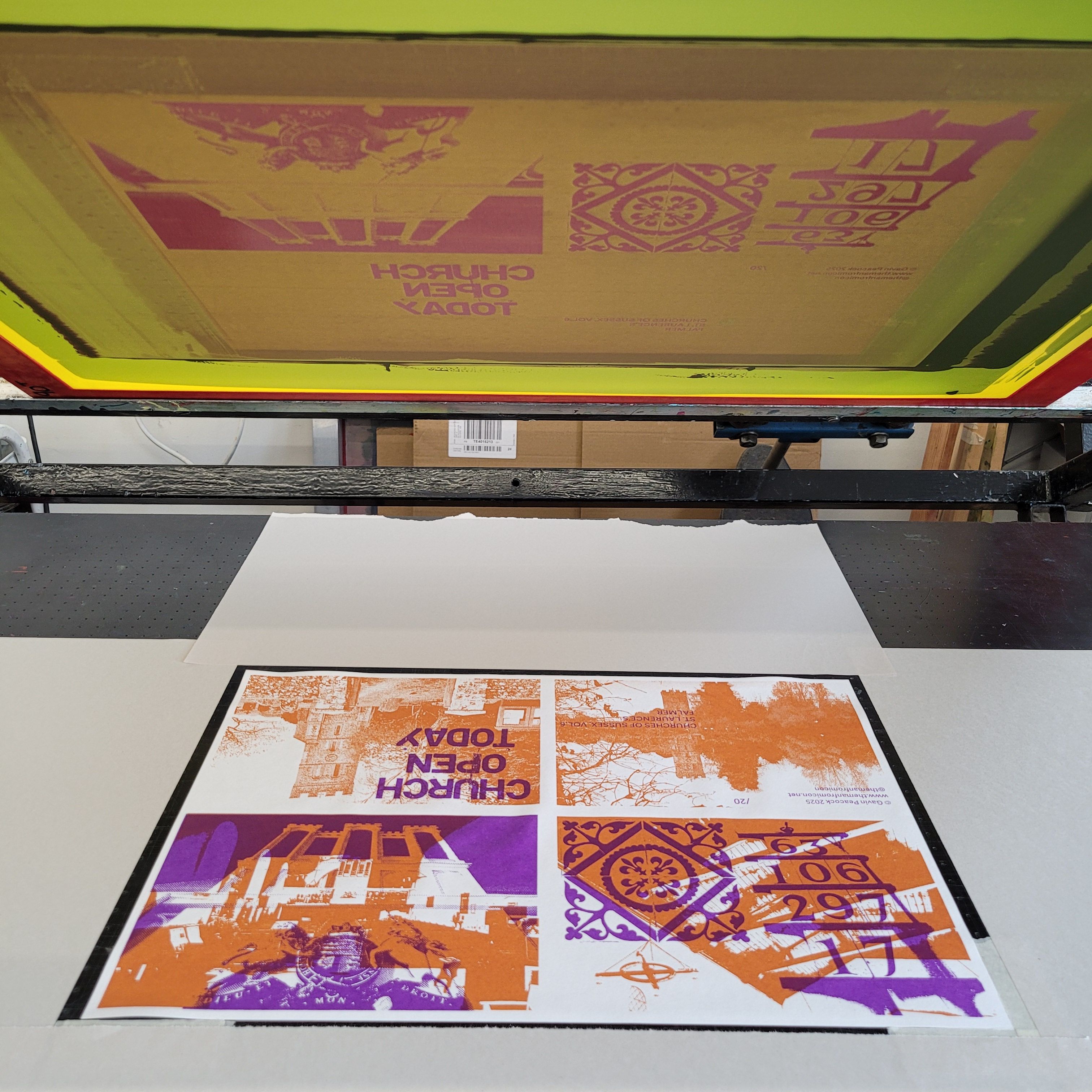
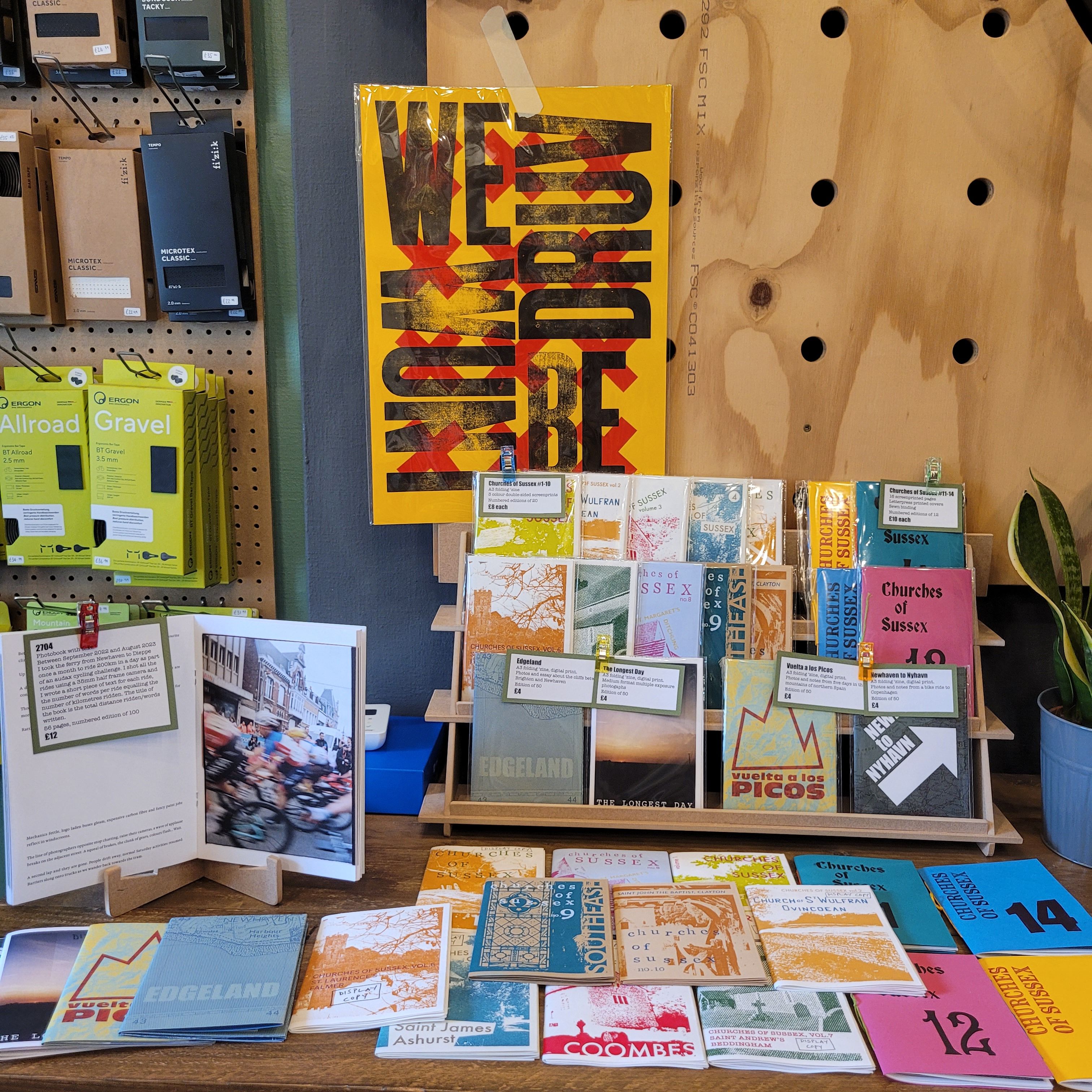
Both the tiles and the Churches of Sussex ‘zines will be on display during Artists Open Houses in Brighton in May 2025. The ‘zines are also available to purchase from me via Instagram.


 the man from icon
Leave a reply to lynnefrancophile Cancel reply